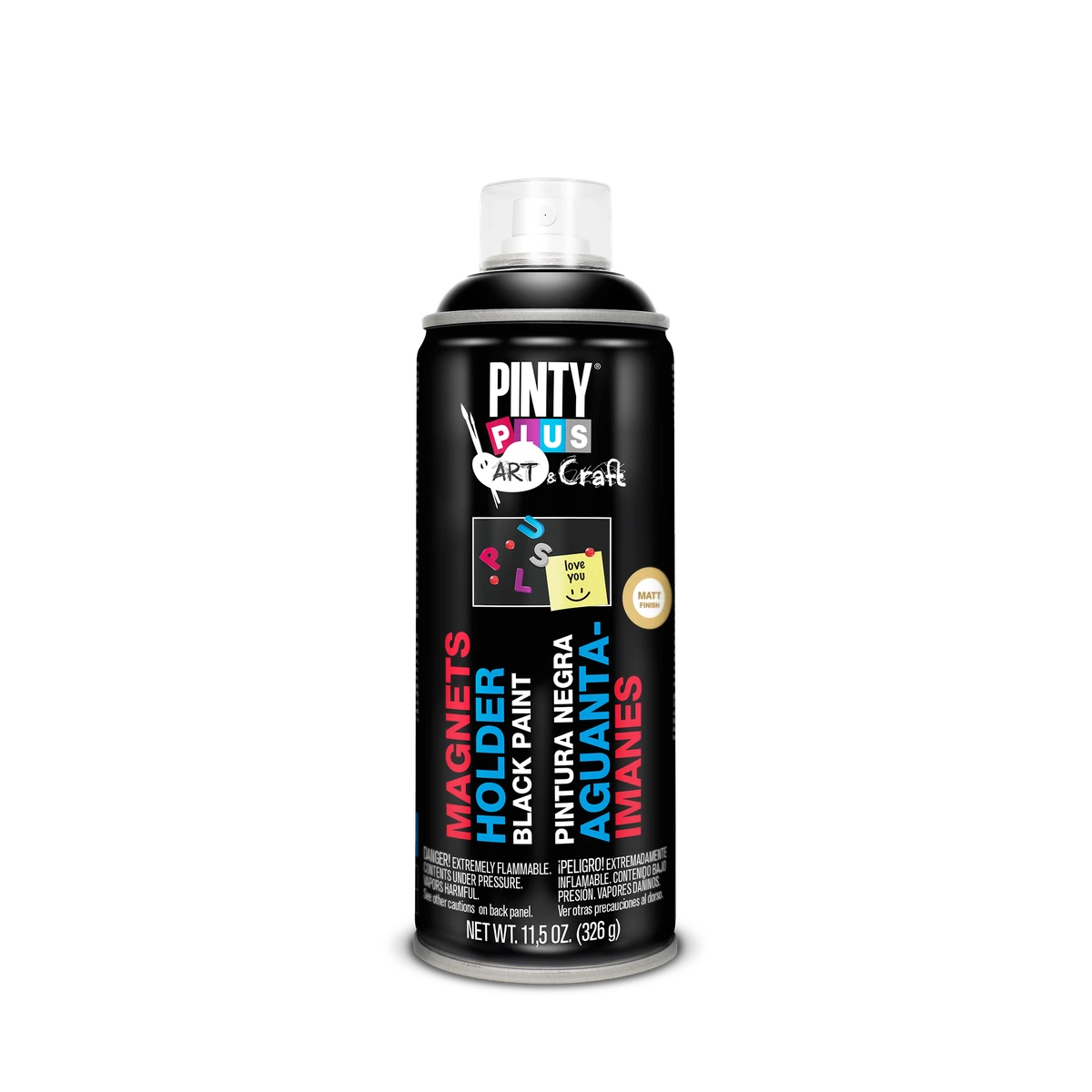
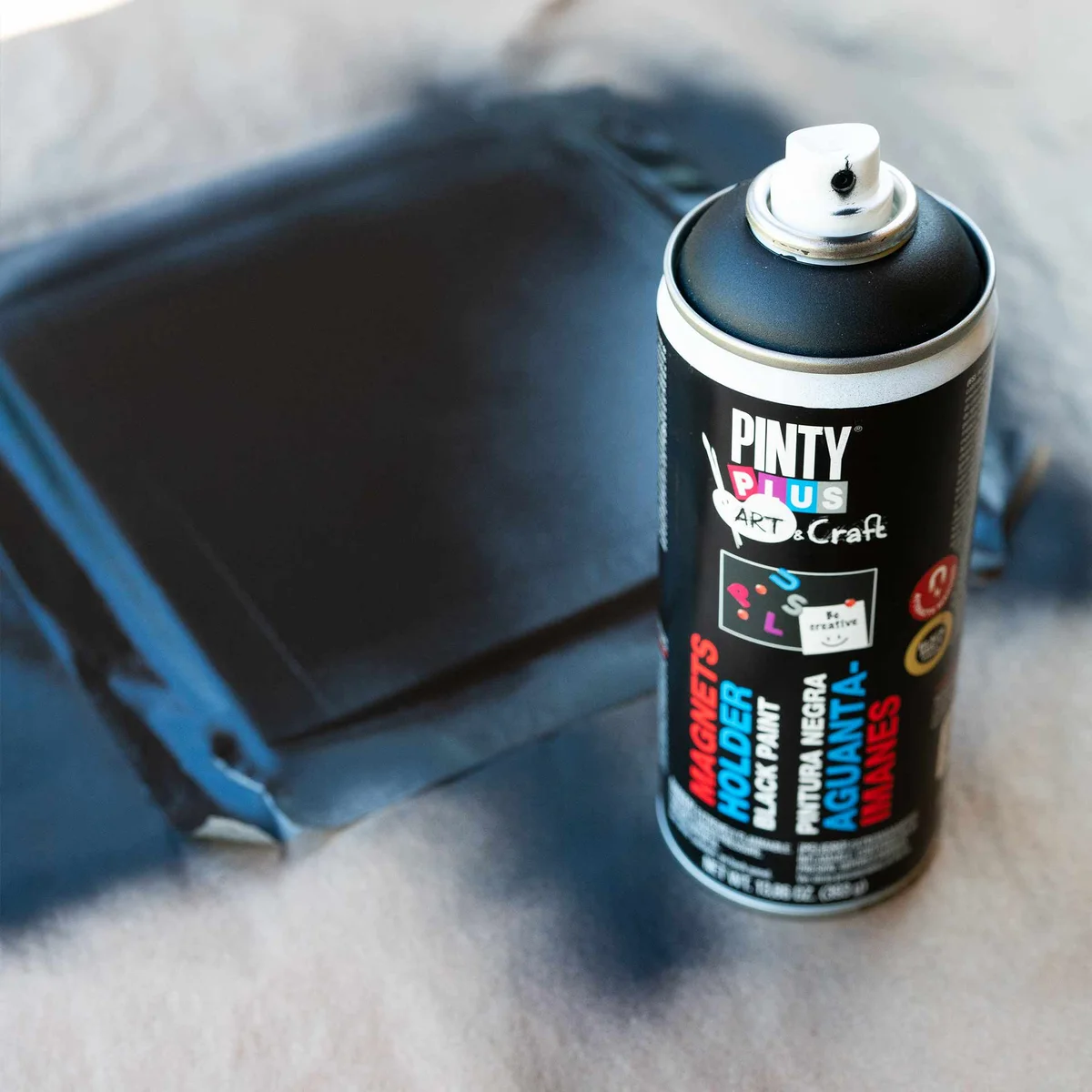
Magnetic paint lets you stick light, flat magnets to a wall, a door or a board without nails, pins or tape. Pintyplus Magnetic Paint is a spray coating containing metallic particles, and the more coats you build up, the stronger it holds. Pintyplus says two coats is the minimum. If you want to paint a colour over it, apply at least four magnetic coats first, let them dry properly, and keep the colour coat thin. It is made for light, flat magnets such as notes, flashcards and fridge-style magnets, not for hanging heavy objects.
The short version
- Product: Pintyplus Magnetic Paint Spray, 400 ml
- Coats: at least 2 for magnets to hold, at least 4 if you will paint a colour over it
- Between coats: after 5 minutes and no later than 1 hour
- Surfaces: wood, metal, stone, rigid plastics and other properly primed surfaces
- Holds: light, flat magnets. Heavier or uneven magnets hold less well.
- Coverage: 1.5 m² per can for one coat
How does magnetic paint work?
The paint doesn’t become a magnet. It contains metallic elements, and once it is on the wall, those particles give a magnet something to pull on. Each extra coat adds more of them, which is why Pintyplus says attraction increases with more coats.
That also explains its limits. A thin layer of paint can only hold so much, so it works with light, flat magnets. A heavy magnet, a thick three-dimensional one, or anything with weight hanging from it will slide down.
How many coats do you need to hold magnets?
Pintyplus gives a minimum of two layers to get the attraction effect. Two coats will hold light paper notes with small flat magnets. For flashcards, children’s letter magnets and anything a little heavier, build up more coats. Test with the magnets you actually plan to use after each coat once you pass the minimum.
Timing matters. Pintyplus says to apply the next coat after about 5 minutes and not later than 1 hour. So plan to finish all the magnetic coats in one session.
Can you paint a colour over magnetic paint?
Yes, but it weakens the effect, because the colour coat puts distance between the magnet and the metallic layer. Pintyplus recommends at least four magnetic layers before a colour coat. Our product page adds that thick decorative topcoats reduce the magnetic effect, and Pintyplus specifically warns that thick paints such as its chalk paint will make the attraction disappear. Keep the colour coat thin.
Wait before overpainting. The Pintyplus product page gives 24 hours before repainting with your chosen paint. Our product page, going by the technical data, gives 5 days before applying a different paint. If you are unsure, wait the longer time.
A magnetic chalkboard is possible in principle, with the blackboard coats on top, but test it on a board first. Our guide to chalkboard walls, doors and menu boards covers the blackboard side.
Where does a magnetic wall make sense?
- Classrooms and tuition centres, for flashcards, charts and pupils’ work without pins in the wall
- Offices, for a planning wall or project board beside a desk
- Kitchens, for shopping lists, school notices and recipes
- Children’s study corners and play areas, with magnetic letters and numbers
- Shop counters and studios, for notices and mood boards on a cabinet side or a door
Pick a defined area rather than a whole wall. A panel at the height people will use is easier to coat well, and it saves paint.
How do you apply magnetic paint, step by step?
1. Prepare and prime the surface
The surface must be clean, dry and free of dust, grease and loose paint. Pintyplus lists wood, metal, stone and rigid plastics, and our product page adds other properly primed surfaces. Prime bare plaster, wood or MDF first. Pintyplus Universal Primer is listed for wood, plaster, metal and rigid plastics.
2. Mark and mask the area
Tape a neat rectangle and cover the floor and nearby furniture. Spray drifts further than you expect.
3. Shake well
Shake the can for one minute, and give it another shake between coats.
4. Spray thin coats from 25 cm
Hold the can about 25 cm from the surface and spray thin, even passes. Wait about 5 minutes between coats, and finish all your coats within the hour window.
5. Let it dry, then test
It dries in about 30 minutes. Test with your magnets before deciding whether to add more coats or a colour.
6. Clear the nozzle
Turn the can upside down and spray until only gas comes out. Work in a well-ventilated place, and keep the spray away from anything connected to the electricity supply.
How much paint will you need?
Pintyplus rates one can at 1.5 m² for a single coat. With the minimum two coats, one can covers roughly 0.75 m², about the size of a large notice board. With four coats, it covers roughly 0.4 m². For a classroom panel or an office planning wall, plan on several cans.
Common questions
Will it hold a picture frame or a shelf?
No. It is designed for light, flat magnets, such as paper notes and flashcards.
Can I use it on a painted wall?
On a sound, clean, properly primed painted surface, yes. Test a small area first.
What colour is it?
It is a functional base coat. If you want a particular colour, paint a thin coat over at least four magnetic coats once they have dried.
Why are my magnets sliding?
Usually too few coats, a thick topcoat, or magnets that are too heavy. Add more magnetic coats or use lighter, flatter magnets.
Where to buy in Lahore and across Pakistan
Pintyplus Magnetic Paint Spray is ₨ 4,190 for a 400 ml can. You can pick it up from our shop at Sohail Centre, LG 8, Dil Muhammad Road, Garhi Shahu, Lahore, Monday to Saturday from 8:30 AM to 10:00 PM, or order online for delivery anywhere in Pakistan.
Not sure which one you need? Send a photo on WhatsApp to 0321 999 3919 and we’ll tell you.