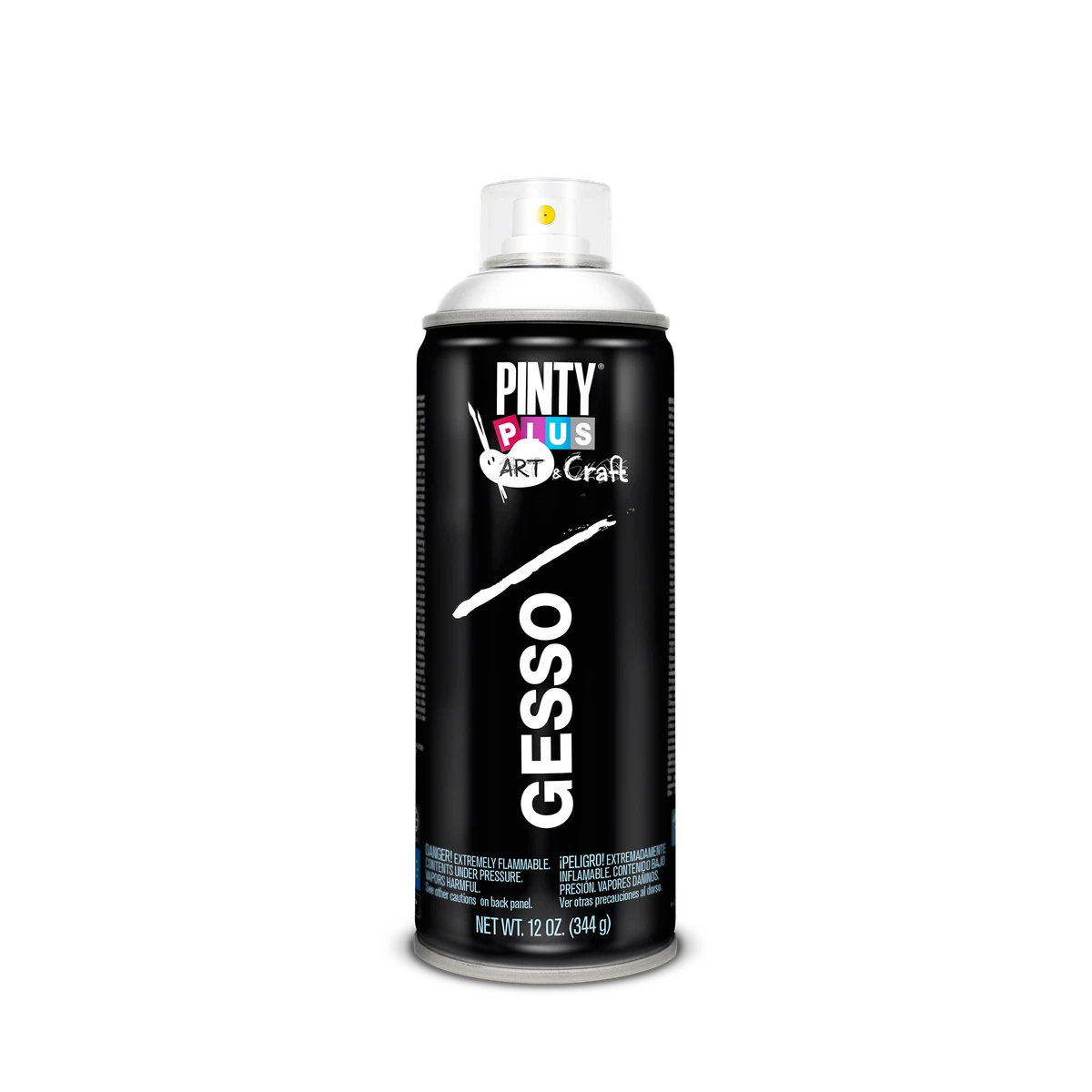
Use gesso primer spray when you are about to paint on an absorbent surface such as raw canvas, wood, MDF, plywood, cardboard or papier-mâché, and you want the paint to sit on top, grip well and show its true colour. Pintyplus Gesso Primer is a white matte spray gesso that prepares those surfaces for any kind of paint. Two thin coats is the usual starting point. For a smooth painting surface, add a few more thin coats and sand lightly once dry. Once the gesso is dry, you can paint straight away.
The short version
- Product: Pintyplus Gesso Primer Spray, white matte, 400 ml
- For: canvas (cotton, linen, polyester), wood, plywood, MDF, plasterboard, cardboard, papier-mâché, walls and concrete
- Coats: two thin coats. Several thin coats with light sanding for a smooth surface.
- Drying: surface dry in 30 minutes, fully dry in 24 hours
- Paint over it: as soon as it is dry, with any kind of paint
What does gesso do?
Absorbent surfaces drink paint. On raw canvas or bare wood, the first layers soak into the fibres, colours look dull and patchy, and you use far more paint than you should. Gesso seals the surface so paint sits on top, gives it a slight tooth to grip, and provides an even white base so colours look bright.
Pintyplus says its gesso helps paint adhere to different types of absorbent surfaces, with or without relief, and prepares them for all kinds of paints. Our product page adds that it can also act as a filler and sealer, and that thin coats can be sanded to build a smoother surface.
When should you use gesso?
- Raw canvas you have stretched yourself
- Wooden panels, MDF and plywood boards for painting
- Cardboard, mount board and papier-mâché for crafts and school projects
- Plasterboard and walls before a mural
- A ready-primed canvas that still feels thin or absorbent, where an extra coat evens it out
For art students, spray gesso saves a lot of time over brushing gesso onto a stack of boards, and it gives an even coat without brush marks.
When is gesso the wrong primer?
Our product page says gesso is best suited to absorbent art and craft surfaces. On smooth, non-absorbent materials such as metal, glass, glossy plastic or melamine, it has nothing to soak into. For those, use Pintyplus Universal Primer, which is listed for metal, rigid plastics, melamine and Formica as well as wood and plaster.
How many coats of gesso do you need?
Pintyplus recommends two thin layers rather than one thick layer. That is enough for most canvases and boards where a little texture is fine.
If you want a smooth surface, for detailed work or fine brushwork, Pintyplus suggests applying several thin coats, letting them dry and sanding lightly. Build it up in thin layers. One heavy coat is more likely to run, and it hides the texture of the canvas completely.
How do you apply spray gesso, step by step?
1. Prepare the surface
The surface must be clean, dry and free of dust and grease. Brush dust off canvas, and give wood or MDF a light sand and wipe.
2. Shake the can
Shake vigorously for one minute after you hear the mixing balls.
3. Spray thin, quick coats
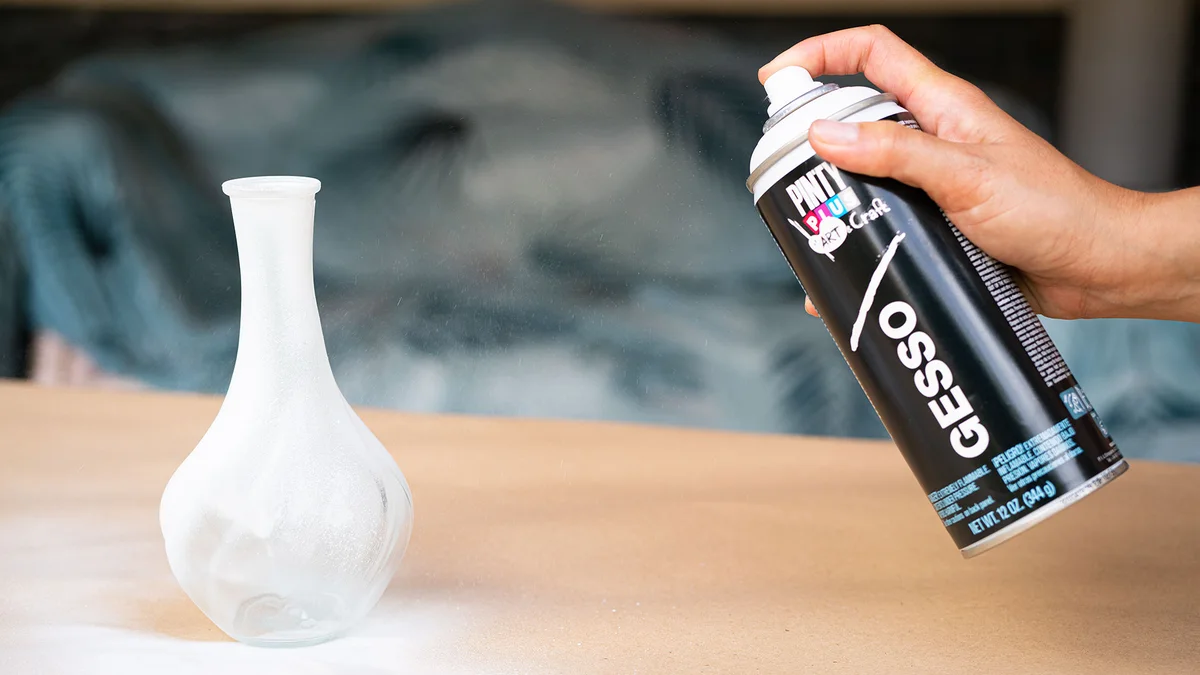
Hold the can 25 to 30 cm from the surface and spray thin, quick passes, first horizontally and then vertically. On a stretched canvas, lay it flat or stand it upright, and include the edges if you plan to paint them.
4. Let each coat dry
The surface is dry in about 30 minutes. Apply the next thin coat once the previous one is dry.
5. Sand lightly for a smooth finish
When you want a smoother surface, sand lightly with fine sandpaper once the coats are dry, dust off, and add another thin coat if needed.
6. Clear the nozzle
Turn the can upside down and spray until only gas comes out.
What should artists in Pakistan keep in mind?
Dust is the enemy of a smooth ground. In a Lahore summer, spray in a closed, clean room with the window open for ventilation, not on an open roof where dust blows onto the wet coat. In monsoon humidity, gesso takes longer to dry, so give each coat extra time before sanding or painting.
If you are priming a batch of boards for a class or a portfolio, lay them all out and do the coats in rounds. By the time you finish the last board, the first is ready for its next coat. Work in a ventilated space and keep the spray away from anything connected to the electricity supply.
Common questions
Can I paint with oils over it?
Pintyplus says it prepares the surface for all kinds of paints. Let it dry fully first.
How long before I can paint?
Pintyplus says that once dry, it can be painted immediately. The surface dries in about 30 minutes, and full drying takes 24 hours.
How much will one can cover?
About 2 m² for one coat, which is roughly 1 m² with two coats. That covers several medium canvases.
Do I need to varnish the painting afterwards?
That depends on the paint. Our guide to varnishing an acrylic painting covers the finishing stage.
Where to buy in Lahore and across Pakistan
Pintyplus Gesso Primer Spray is ₨ 3,670 for a 400 ml can. You can pick it up from our shop at Sohail Centre, LG 8, Dil Muhammad Road, Garhi Shahu, Lahore, Monday to Saturday from 8:30 AM to 10:00 PM, or order online for delivery anywhere in Pakistan.
Not sure which one you need? Send a photo on WhatsApp to 0321 999 3919 and we’ll tell you.
More on primers: Primers & Surface Preparation