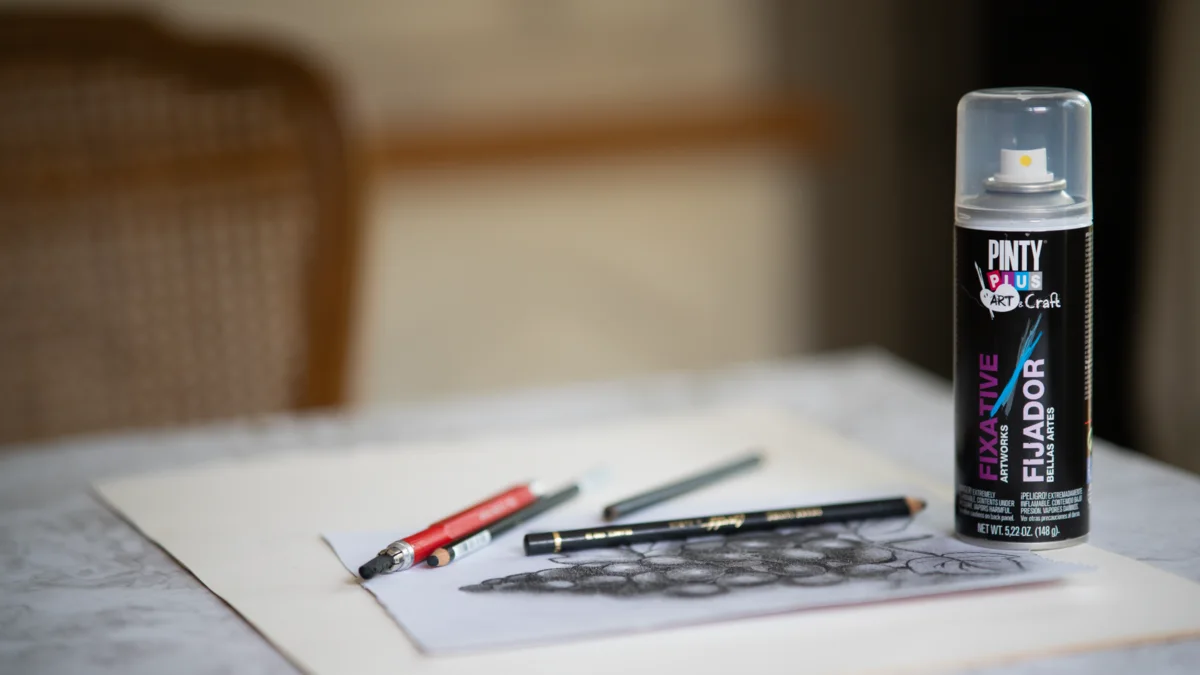
Workable fixing means spraying a very light coat between stages of a drawing, so the layers underneath stop smudging and you can keep working on top. Final fixing means two thin coats when the drawing is finished, to protect it. Some brands sell separate cans for each. We stock one: Pintyplus Fixative Spray for Charcoal & Pastel, which Pintyplus describes as a clear, waterproof, everlasting fixative that doesn’t yellow. That makes it a natural final fixative. You can also use it lightly between stages, as long as you test first on a scrap of the same paper and medium.
At a glance
| Stage | What to do |
|---|---|
| After the first layout or underdrawing | One very light mist, if the lines are smudging |
| Between heavy layers | One very light mist, dry, then test the surface |
| End of each session | A light mist, so the drawing survives until next time |
| Before final highlights | Fix the layers underneath, then add highlights |
| Finished drawing | Two thin coats from 25 to 30 cm |
What is the difference between workable and final fixative?
A workable fixative is meant to be used during a drawing. It holds the layers underneath so you can draw over them without muddying the colours, and it leaves enough surface for the next layer of pastel, charcoal or pencil to grip.
A final, or permanent, fixative is meant for the end. It is applied once the drawing is finished to protect it from smudging, handling and moisture.
In practice, the difference is as much about how you spray as what is in the can. A very light mist interferes little with the surface. Several coats seal it more.
Which one is the Pintyplus fixative?
Neither our product page nor Pintyplus labels it as workable or permanent. Pintyplus describes it as an everlasting fixative that is clear and colourless, fast drying, waterproof and non-yellowing, and lists it for watercolours, pencils, pastels, crayons, charcoal and ink. That description fits a final fixative best.
Many artists use one fixative both ways, with a very light mist between stages and fuller coats at the end. If you do this with ours, test on a scrap first, because each paper and medium reacts a little differently.
When should you fix a drawing mid-process?
- After the underdrawing, if charcoal or pencil lines are smearing into the colours you add next.
- When you switch from one medium to another, for example from charcoal to pastel.
- When the paper stops taking more pastel, because the grain is filled.
- At the end of a session, if the drawing will be moved, stored or carried before you continue.
- Before the final bright highlights, so they go on top of fixed layers and stay clean.
You don’t have to fix at every stage. If the drawing isn’t smudging and you are still blending, carry on.
How do you fix between layers?
1. Test first
On a scrap of the same paper, lay down the same media, give it one light mist, let it dry and try drawing over it. This tells you how much surface is left.
2. Shake and set up
Shake the can well. Our product page says about 30 seconds and Pintyplus says one minute. Prop the drawing up in a ventilated place with no wind and the ceiling fan off.
3. Spray one very light mist
Hold the can 25 to 30 cm away and make one quick pass across the drawing, first horizontally and then vertically, starting and ending off the paper. It should never look wet.
4. Let it dry, then carry on
It dries in about 10 minutes. Then continue drawing.
How do you do the final fix?
When the drawing is finished, photograph or scan it first, in case the fixative changes the look slightly. Then spray two thin coats from 25 to 30 cm, first horizontally and then vertically, letting the first dry for about 10 minutes before the second. Pintyplus recommends two thin layers instead of one thick one. Finish by turning the can upside down and pressing until only gas comes out.
For more on avoiding dull colours with pastel and charcoal, read our guide to fixative spray for pastel and charcoal.
Common questions
Can I erase after a light mid-process fix?
Much less easily. Treat any fixed layer as settled.
Will fixing between layers darken my colours?
Heavy coats of any fixative can darken pastel. A single light mist keeps this to a minimum.
Can I fix a drawing in a humid room?
Choose a dry day and a ventilated space. In monsoon weather, give each coat longer than 10 minutes before you touch the drawing.
How much will one can fix?
A 200 ml can covers about 1 m², which goes a long way with light mists.
Where to buy in Lahore and across Pakistan
Pintyplus Fixative Spray for Charcoal & Pastel is ₨ 2,295 for a 200 ml can. You can pick it up from our shop at Sohail Centre, LG 8, Dil Muhammad Road, Garhi Shahu, Lahore, Monday to Saturday from 8:30 AM to 10:00 PM, or order online for delivery anywhere in Pakistan.
Not sure which one you need? Send a photo on WhatsApp to 0321 999 3919 and we’ll tell you.