You have just finished a pencil drawing that took hours of careful, patient work. The shading is smooth, the highlights are crisp, and every detail sits exactly where it should. Now comes the anxiety that every pencil artist knows: how do you keep it that way?
Pencil graphite, like charcoal, does not bond chemically to paper. It rests on the surface, and that means it is always at risk of smudging, lifting, or fading — especially when exposed to handling, storage, or atmospheric moisture over time. A good fixative spray for pencil drawings is the solution artists have relied on for generations.
Why Pencil Drawings Need Fixative Protection
Graphite is a form of carbon — specifically a crystalline lattice of carbon molecules that has a naturally slippery, reflective quality. This is what gives pencil marks their characteristic sheen and makes blending so smooth. But that same slipperiness is also why pencil marks rub off easily. Every time you touch a finished drawing, you risk displacing some of those graphite particles.
Over time, even untouched pencil drawings can be affected by environmental factors. Humidity can cause paper fibres to expand and shift, carrying graphite particles with them. Dust settling on the surface can abrade fine lines. Light pressure from a covering sheet can transfer graphite to whatever the drawing is stored against.
A drawing fixative spray creates a thin, transparent protective coat that binds the graphite particles in place. Once cured, the drawing becomes significantly more resistant to all of these risks.
Workable Fixative: The Secret Tool for Multi-Layer Pencil Work
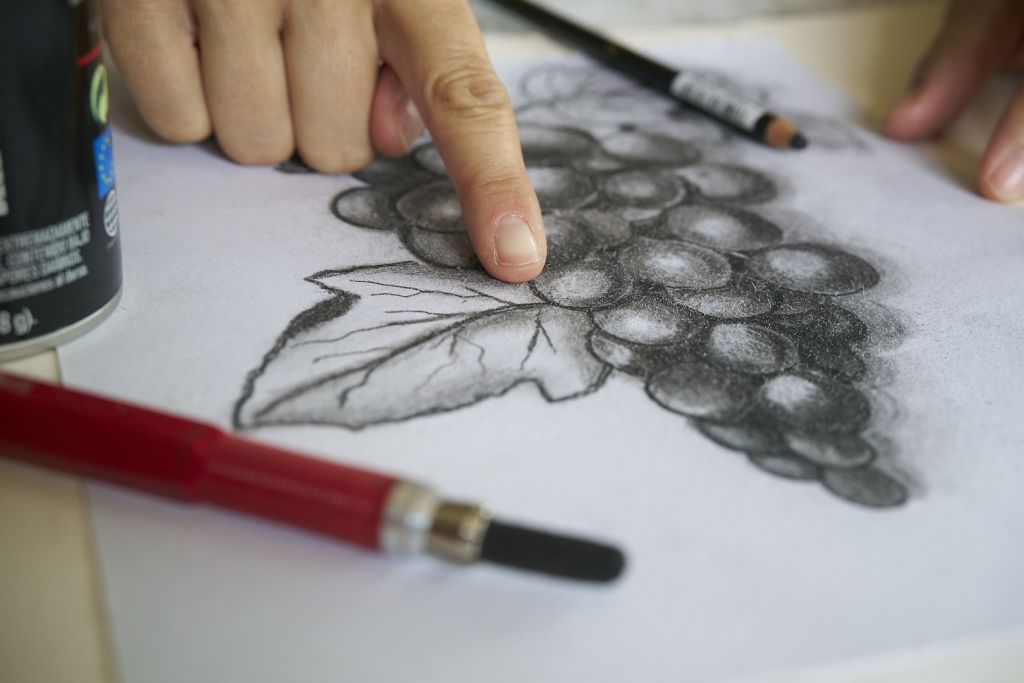
Many pencil artists — especially those working in realistic or hyper-realistic styles — build their drawings in multiple layers. They begin with light guidelines, add mid-tones, then deepen shadows progressively, often using different grades of pencil from 2H all the way down to 8B or even graphite powder.
A workable fixative spray is ideal for this kind of layered workflow. After completing the early-stage linework, a light application of workable fixative locks in those underlying lines so they do not get disrupted when you continue working on top. This is especially useful when blending with a tortillon or finger, as the pressure can sometimes disturb earlier marks.
The key word is ‘workable’ — the surface remains receptive to further pencil strokes. You can erase over it, add more graphite, and blend as usual. Artists who understand this technique often achieve smoother tonal transitions and more controlled results than those working without fixative between layers.
Does Fixative Change the Appearance of Pencil Drawings?
This is one of the most common questions pencil artists ask, and the honest answer is: it can, but it does not have to. Low-quality or incorrectly applied fixative can slightly darken a pencil drawing or create a subtle sheen that was not there before. However, a quality sketch fixative spray applied in thin, even coats will preserve the original look of the drawing almost perfectly.
It is always a good idea to test your chosen fixative on a small scrap drawing before applying it to a finished piece. Observe how it affects tone, texture, and the ability to continue working. Once you know exactly how the product behaves, you can use it confidently on your best work.
Some artists do notice a very slight darkening effect, particularly on the lighter tones of a drawing. If this is a concern, apply an extremely light first coat from a slightly greater distance than usual. This partial application will protect without significantly altering the visual balance.
Application Guide: Getting the Best Results
The method of application has a direct impact on the quality of the result. These guidelines will help you get consistent, professional outcomes every time:
- Always work in a ventilated space. The solvent in fixative spray is not something you want to breathe in an enclosed room.
- Lay your drawing flat or prop it at a slight angle. Spraying a drawing held vertically can cause the fixative to run before it dries.
- Shake the can well — at least 45 seconds — before every use to ensure the formula is fully mixed.
- Start spraying before the nozzle reaches your drawing and finish the pass after it has moved past the edge. This prevents concentrated buildup at the edges.
- Use 2 to 3 light passes rather than one heavy coat. Heavy single-coat application is the most common cause of blotching or tonal disruption.
- Allow each coat to dry completely — at least 5 minutes — before assessing whether a second coat is needed.
Long-Term Storage After Fixing
Once you have applied a fixative spray for pencil drawings, the artwork is significantly more stable. But good storage habits still matter. Place fixed drawings in archival-quality portfolios or acid-free sleeves. If stacking multiple pieces, interleave them with acid-free tissue or glassine paper to prevent any surface contact.
For very valuable or exhibition-ready pieces, consider framing behind UV-protective glass after fixing. Ultraviolet light causes paper to yellow and graphite to subtly fade over very long periods. UV glass eliminates that risk entirely.
With a quality fixative application and proper storage, a pencil drawing can last indefinitely without losing its clarity or detail.
Building Good Habits as a Pencil Artist
The best artists treat fixative spray as a routine part of their practice, not an emergency measure after something has already gone wrong. Keeping a can in your supply kit and applying it as a standard final step on every finished drawing will protect years of work and development.
For students and hobbyists especially, your sketchbooks and practice drawings represent a record of your growth as an artist. Protecting those drawings means protecting that history. A fixative spray for pencil drawings is one of the simplest, most effective investments you can make in your creative journey.